
Bitchat: What Offline Messaging Teaches Us About Resilience
What happens to your communications plan when the internet disappears? Bitchat offers a useful way to explore local connectivity, shared dependencies, and the limits of offline mes
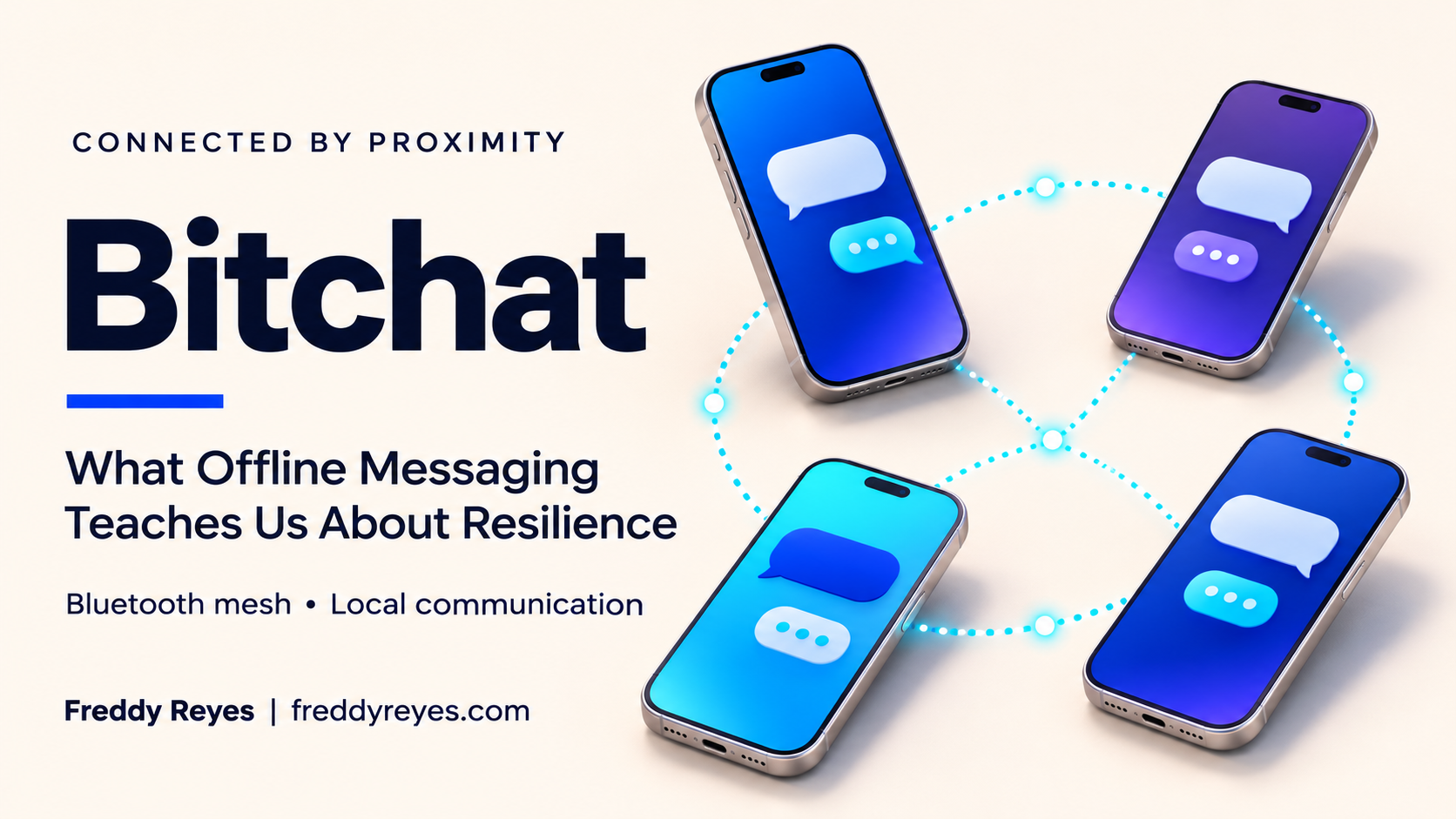
A communications plan can look redundant on paper: a primary messaging app, a backup app, and email.
But what happens when all three depend on the internet connection that just failed?
That question is what makes Bitchat interesting to me. Its local messaging architecture gives us a practical way to think about connectivity when the usual infrastructure is unavailable.
How nearby phones become the network
Bitchat is an open-source messaging application whose local mode uses Bluetooth Low Energy. Nearby participating devices discover one another and can relay messages across multiple hops. That Bluetooth path works without an internet connection, a phone number, or a central messaging server. [1]
Think of several people spread through a building. Two might be too far apart for a direct Bluetooth connection, while other participating devices between them could provide a relay path.
That is a conceptual example, not a range promise. Whether the message gets through depends on the devices, their positions, radio conditions, and whether they remain available to relay it.
The key architectural idea is simple: the people carrying the devices also carry pieces of the network.
Offline messaging and internet messaging are different paths
The current project documentation describes two transports:
| Path | How it works | Main dependency |
|---|---|---|
| Local Bluetooth mesh | Participating nearby devices discover peers and relay messages | Usable Bluetooth links and available peers |
| Internet-based Nostr | Messages travel through decentralized relays; the app also supports geographic public channels | Internet access and reachable relays |
Bitchat’s documented routing can use Bluetooth or an internet path, depending on availability. Its whitepaper also describes bounded store-and-forward mechanisms for messages that cannot be delivered immediately. [2]
Those capabilities deserve careful wording. An internet relay does not provide global offline reach. A queued message still needs a later opportunity to reach its recipient.
Where I would evaluate it
I see potential value in testing this model for people who expect to be physically near one another: an event team, a group outdoors, or neighbors exploring an additional local communications channel.
A useful evaluation starts with a specific question: Can these people exchange the messages they need, in this location, under the conditions they expect?
A successful exchange between two phones in the same room answers only a small part of that question. It does not establish coverage across a venue, reliable background operation, or delivery during a disruption.
For hurricane preparedness, for example, my interest would be in testing a supplemental neighborhood channel in advance. I would keep that experiment within a broader plan with agreed check-in procedures and other communications options.
The limits belong in the conversation
Bluetooth mesh depends on participation and physical conditions. Installing an app does not create a usable network if the intended recipients and relay devices are absent.
Walls, distance, battery levels, permissions, and operating-system behavior are all conditions I would include in an evaluation. Rather than quote a universal coverage distance, I would measure what works with the actual phones and locations involved.
Privacy needs the same precision. Bitchat’s documentation describes end-to-end encryption for private messages. Public mesh and geographic channels are public to their participants. Its privacy assessment also explains that stable application identifiers and observable radio activity can allow nearby observers to recognize a device across sessions. Optional internet features introduce relay and network metadata exposure. [4]
That makes “encrypted private messages” a much more useful description than a blanket promise of anonymity.
A practical test before relying on it
My starting test plan would be:
- Install in advance. Use the download links on the official website, which points to iPhone and Android distribution options. [1]
- Confirm the offline path. Disable Wi-Fi and cellular data while keeping Bluetooth enabled. Verify that local messages still travel.
- Use representative devices and spaces. Test the phones people actually own, including the iPhone/Android combinations the group needs.
- Test disruption deliberately. Lock screens, put apps in the background, move a relay device away, and observe reconnection and delivery.
- Measure recipient receipt. Record delays and failures. A message appearing on the sender’s screen is insufficient evidence of delivery.
- Agree on the fallback. Decide what people do when a message receives no acknowledgment.
These are proposed evaluation steps. This article is based on the project’s documentation, not a hands-on field test.
The broader lesson for technology leaders
Bitchat prompts a useful review of any continuity plan: Which dependencies do our backup channels share?
Two services may have different logos while still relying on the same access network, identity service, device, or power source. Mapping those dependencies helps reveal where an apparent backup could fail alongside the primary service.
A local mesh removes some dependencies and introduces others. That tradeoff is exactly what makes it worth understanding.
For me, the value of Bitchat is both the application and the design question it raises: what communication can we preserve when part of the infrastructure is gone?
Sources
Project documentation and listings reviewed November 18, 2026. Features can vary by platform and release.