
Agents, Loops, and Graphs: A Practical Framework for Building Better AI Systems
Most people still interact with AI in a very linear way: Prompt → Answer → Fix → Prompt again. That is useful, but it is only the beginning. The more interesting shift happens when
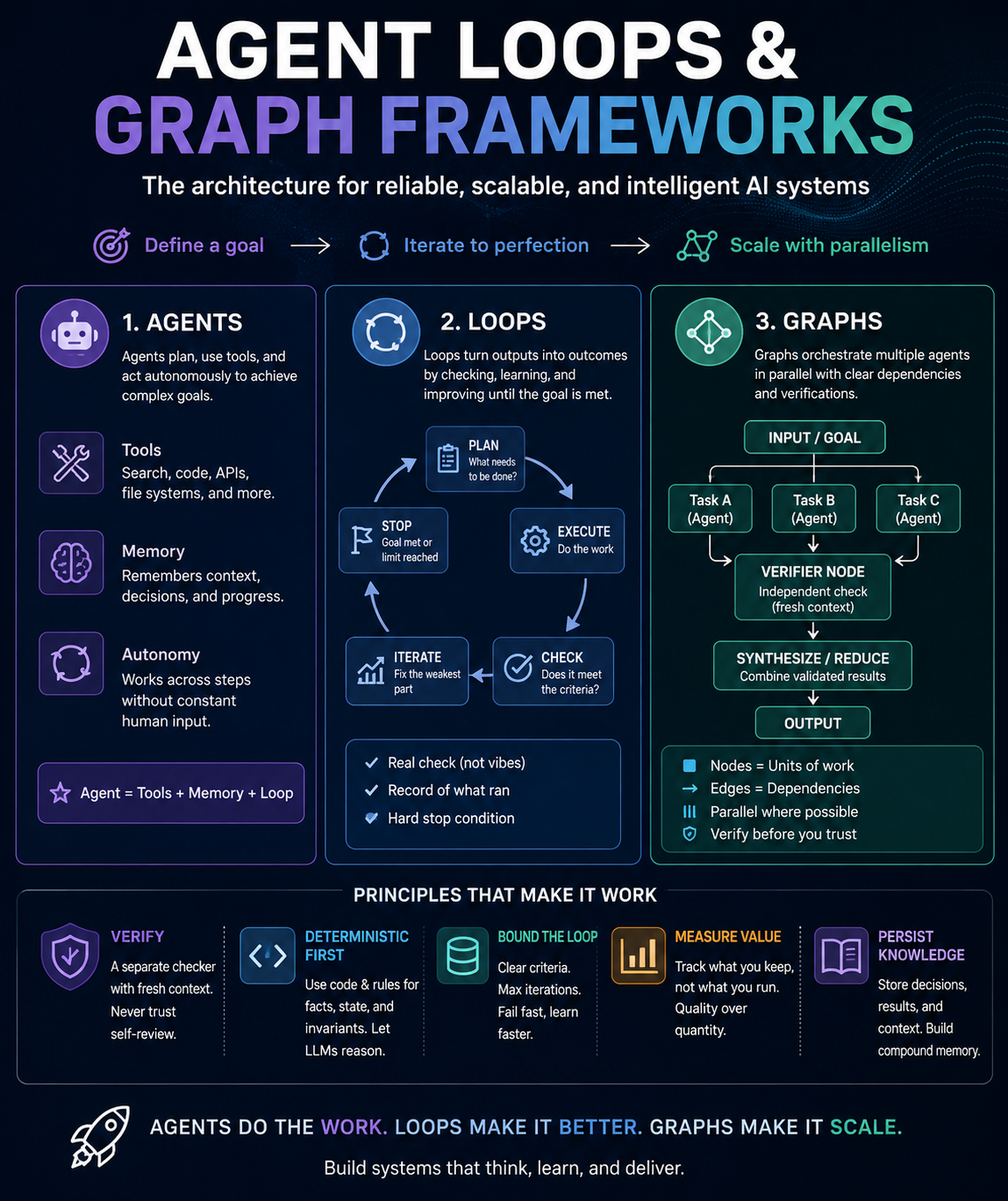
1. Agents: Give AI a Goal, Not Just a Prompt
A traditional prompt asks a model to produce an answer.
An agent is given an objective and the ability to take multiple actions toward achieving it.
For example:
“Summarize this document” is a prompt.
But:
“Research the three major approaches to this problem, compare their strengths and weaknesses, verify the important claims, and produce an executive recommendation”
is an agentic task.
An effective agent typically has access to three capabilities:
Tools — search, APIs, databases, files, code execution, business applications.
Memory — information about what has already happened, previous decisions, constraints, and progress.
Autonomy — the ability to choose and execute multiple steps without requiring human intervention after every action.
The model is only part of the system.
The tools, state, rules, and orchestration around the model are what make the agent useful.
2. Loops: Don’t Stop When Something Is Generated
One of the biggest mistakes in AI workflows is assuming that generation equals completion.
It doesn’t.
A useful AI system needs some way to determine whether its output actually satisfies the objective.
That creates a loop:
PLAN → EXECUTE → CHECK → ITERATE → STOP
The important component isn’t iteration.
It’s the check.
Without a meaningful check, the system is simply asking the model to rewrite its own work repeatedly.
A good loop needs an objective condition that can fail.
Examples include:
- Did the code pass its tests?
- Are all required fields populated?
- Does every factual claim have evidence?
- Did the output conform to the expected schema?
- Were mandatory requirements addressed?
- Did a business rule fail?
Then the system should have a hard stopping condition.
For example:
Maximum three attempts.
If the result still fails validation, escalate it for human review.
That creates what I think of as bounded autonomy.
The goal isn’t to make AI run forever.
The goal is to let it solve what it can, recognize what it cannot, and escalate intelligently.
3. Graphs: Stop Making Independent Work Wait
Once an agent starts performing multiple tasks, another problem appears.
We often structure workflows sequentially simply because that’s how humans write instructions:
Task A → Task B → Task C → Task D
But that doesn’t mean those tasks actually depend on each other.
Consider analyzing a company.
You might need to:
- research the company
- analyze competitors
- identify executives
- review recent news
- analyze financial information
- evaluate market positioning
Most of those tasks can happen independently.
Running them sequentially creates unnecessary latency.
A graph solves that problem.
In an AI execution graph:
Nodes represent units of work.
Edges represent real dependencies.
If Task B requires information produced by Task A, an edge exists.
If it doesn’t, there shouldn’t be one.
That means independent nodes can execute simultaneously.
A common pattern looks like this:
Input
↓
Fan Out
→ Research Agent → Financial Agent → Market Agent → Competitive Agent
↓
Verification
↓
Synthesis
↓
Final Output
This is sometimes called a fan-out / fan-in or diamond architecture.
Instead of asking one giant agent to do everything, specialized workers investigate different dimensions of the problem and their results converge later.
4. The Most Important Node May Be the Verifier
There is a fundamental weakness in asking an AI system to evaluate its own reasoning.
The same assumptions that produced an error can influence the evaluation of that error.
For important workflows, I prefer separating the worker from the verifier.
The worker produces a finding.
The verifier receives the finding without inheriting the worker’s reasoning process and tries to challenge it.
For example, separate verification nodes might ask:
Correctness: Does the claim actually follow from the evidence?
Currency: Is the information still current?
Source validity: Does the underlying source actually support the claim?
Only validated findings move to the synthesis stage.
The idea is similar to engineering practices we already trust:
developers and testers,
authors and editors,
operations teams and auditors.
AI systems benefit from separation of responsibilities too.
5. Don’t Use AI Where Code Works Better
This is where many agent architectures become unnecessarily complicated.
Not every node should be an LLM.
Some decisions are deterministic.
For example:
- Has this record already been processed?
- Is this identifier already in the database?
- Is the deadline in the past?
- Does this JSON match the schema?
- Has the maximum retry count been reached?
- Is this contact marked DO_NOT_CONTACT?
- Does this status transition violate a business rule?
Those questions should usually be answered by software.
Not AI.
I use a simple principle:
Deterministic first. Reasoning second.
Let databases maintain state.
Let software enforce invariants.
Let APIs retrieve facts.
Let tests validate outputs.
Then let AI handle the parts that genuinely require interpretation, ambiguity, synthesis, prioritization, or judgment.
This dramatically reduces hallucination risk and makes AI systems easier to debug.
6. Execution Graphs and Knowledge Graphs Solve Different Problems
There is another distinction I find useful.
An execution graph answers:
What needs to happen next?
A knowledge graph answers:
What do we already know?
Imagine a recruiting system.
A knowledge graph might contain relationships such as:
Candidate → APPLIED_TO → Job
Job → AT → Company
Recruiter → WORKS_AT → Company
Candidate → INTERACTED_WITH → Recruiter
Story → PROVES → Capability
Story → MATCHES → Job Requirement
That persistent graph gives agents context.
The execution graph can then determine what actions should occur.
For example:
New Job ↓ Retrieve existing company knowledge ↓ Run independent match + company + contact analysis ↓ Verify findings ↓ Calculate opportunity score ↓ Recommend Apply / Review / Skip ↓ Update persistent knowledge
Now the system isn’t starting from zero every time.
It is building organizational memory.
7. The Architecture I Keep Coming Back To
The pattern I increasingly prefer looks like this:
Persistent State
Databases, CRM systems, APIs, files, and knowledge graphs maintain what is known.
↓
Specialized Agents
Different agents perform bounded reasoning tasks.
↓
Execution Graph
Dependencies determine what runs sequentially and what runs in parallel.
↓
Verifier Nodes
Independent workers challenge important results.
↓
Bounded Loops
Failed outputs get another attempt—but only within explicit limits.
↓
Deterministic Gates
Software enforces rules that shouldn’t depend on model judgment.
↓
Human Review
Ambiguous or unresolved cases are escalated instead of hidden.
This is not about creating an AI system that does everything autonomously.
It is about designing one that knows:
what it can reason about,
what software should decide,
what needs verification,
what can run simultaneously,
and when a human should take over.
From Prompts to Systems
The evolution looks something like this:
Prompt
“Do this.”
↓
Agent
“Achieve this goal.”
↓
Loop
“Achieve the goal and verify that it worked.”
↓
Graph
“Let multiple specialized agents solve independent parts efficiently.”
↓
Reliable AI System
“Combine agents, deterministic software, persistent knowledge, verification, bounded iteration, and human oversight.”
That last step is where things become interesting.
The future of enterprise AI isn’t one enormous autonomous agent.
It is likely to be a network of specialized reasoning components working alongside deterministic systems, APIs, databases, rules, and humans.
Agents do the work.
Loops make it better.
Graphs make it scale.
And good engineering makes the whole thing trustworthy.
#ArtificialIntelligence #AIAgents #AgenticAI #GenerativeAI #AIEngineering #Automation #EnterpriseAI #SoftwareArchitecture #Innovation #TechnologyLeadership