
Chunking: The Hidden Hero of Great AI Answers
When people talk about building AI applications, the conversation usually revolves around models, embeddings, vector databases, or frameworks. But one of the most important factors
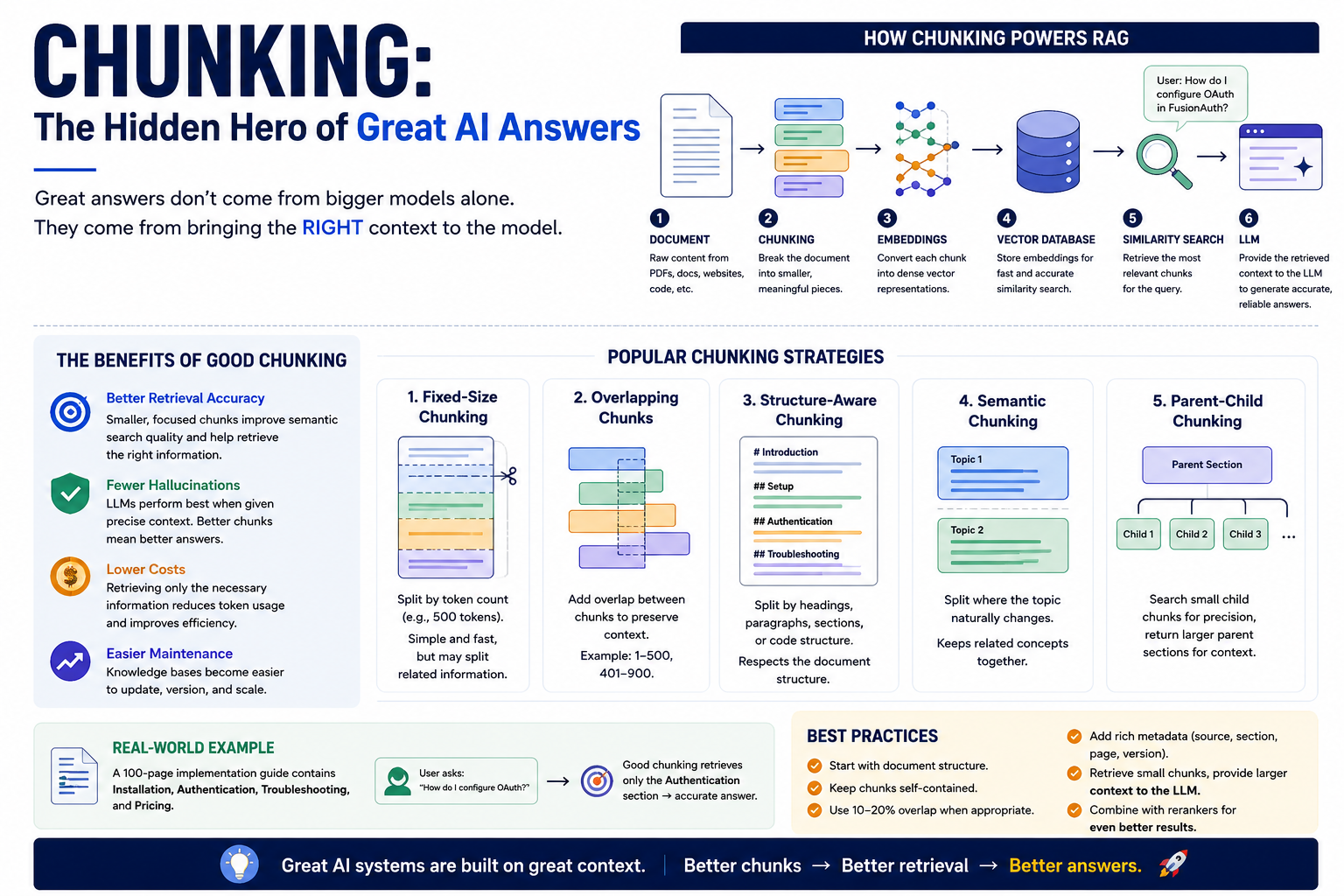
Why Chunking Matters
Large documents contain multiple topics, sections, and ideas. Embedding an entire document into a single vector mixes unrelated concepts together, making retrieval less precise.
Instead, we break documents into smaller chunks:
This allows the retrieval system to provide the model with only the information relevant to the user’s question.
The Benefits of Good Chunking
Better Retrieval Accuracy
Smaller, focused chunks improve semantic search quality and help retrieve the right information.
Fewer Hallucinations
LLMs perform best when given precise context. Better chunks mean better answers.
Lower Costs
Retrieving only the necessary information reduces token usage and improves efficiency.
Easier Maintenance
Knowledge bases become easier to update, version, and scale.
Popular Chunking Strategies
Fixed-Size Chunking
Split documents by token count.
Simple and fast, but can separate related information.
Overlapping Chunks
Introduce overlap between chunks to preserve context.
Example:
- Chunk 1: 1–500 tokens
- Chunk 2: 401–900 tokens
This approach prevents important information from being split apart.
Structure-Aware Chunking
Respect the structure of the document by splitting on:
- Headings
- Paragraphs
- Sections
- Functions (for source code)
This often produces much better retrieval quality than arbitrary token boundaries.
Semantic Chunking
Split documents where topics naturally change.
Rather than cutting every 500 tokens, semantic chunking keeps related concepts together and produces more meaningful embeddings.
Parent-Child Chunking
One of the most effective approaches in production systems.
Search is performed against small child chunks for precision, while larger parent sections are returned to the LLM for additional context.
This provides the best of both worlds:
✅ Precision
✅ Context
Real-World Example
Imagine a 100-page Fusion ERP implementation guide containing:
- Installation
- Authentication
- Troubleshooting
- Pricing
A user asks:
“How do I configure OAuth?”
Without proper chunking, the retrieval system might surface irrelevant sections.
With structure-aware chunking, the search retrieves only the Authentication section, allowing the LLM to generate a much more accurate answer.
Best Practices
✔ Start with document structure.
✔ Keep chunks self-contained.
✔ Use 10–20% overlap when appropriate.
✔ Add metadata such as source, section, page, and version.
✔ Retrieve small chunks but provide larger context to the LLM.
✔ Combine chunking with rerankers for even better results.
Final Thought
Chunking may not be the flashiest part of AI engineering, but it’s one of the biggest determinants of retrieval quality.
Many teams spend more time comparing models than improving their retrieval pipeline.
In practice, great AI systems are built on great context.
And great context starts with great chunking.
Better chunks → Better retrieval → Better answers 🚀
#AI #GenerativeAI #RAG #LLM #VectorDatabases #AIEngineering #MachineLearning #Qdrant #AgenticAI #MCP #DataEngineering