
Why Vector Databases Are the Missing Piece for High-Quality RAG Systems
Large Language Models are powerful, but their knowledge is frozen at training time. That creates a challenge for applications that depend on constantly changing information. This i
Why Traditional Search Falls Short
Traditional databases are excellent for exact matches:
- IDs
- Keywords
- Structured data
- SQL queries
But people rarely search using exact words.
Suppose someone asks:
“Which teams have surprised everyone so far in the World Cup?”
Articles and match reports may contain:
- Giant killers
- Underdogs
- Shock results
- Defensive discipline
- Late equalizers
There may be no exact keyword overlap, yet the meaning is clearly related.
Semantic search solves this problem.
How Vector Search Works
Instead of storing text as rows and columns, vector databases store embeddings.
Embeddings are numerical representations of meaning generated by AI models.
For example:
Match Report
“Morocco upset Scotland with a disciplined defensive performance.”
↓
Embedding
[0.183, -0.242, 0.071, …]
When a user submits a question, that question is also converted into an embedding.
The vector database searches for vectors with similar meaning rather than identical words.
This enables:
- Semantic search
- Similarity matching
- Context retrieval
- Natural language questions
RAG Architecture
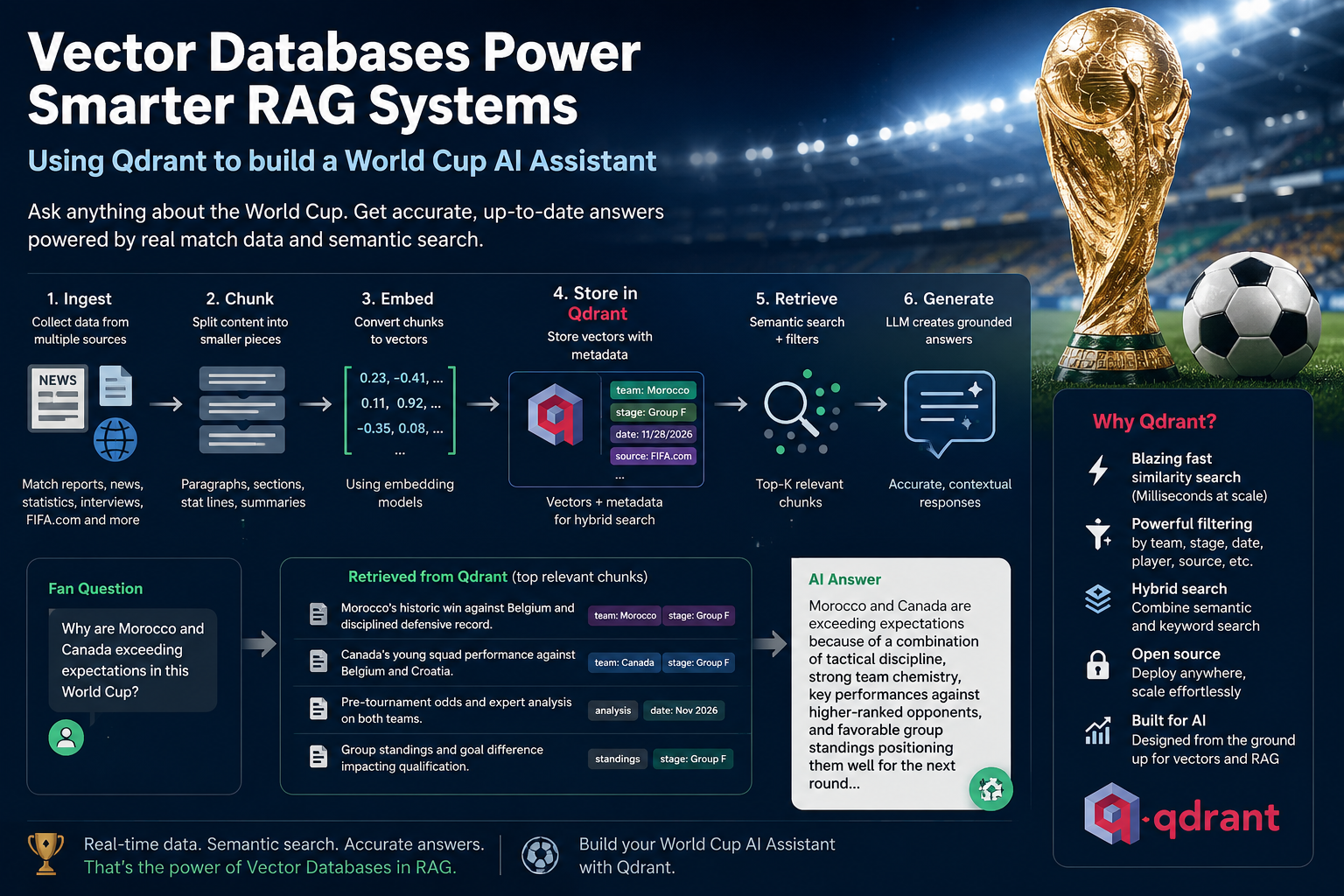
A typical RAG pipeline looks like this:
- Match reports are collected.
- Articles are split into chunks.
- Embeddings are generated.
- Vectors are stored in a vector database.
- A fan asks a question.
- Similar chunks are retrieved.
- Relevant context is added to the prompt.
- The LLM generates an answer.
The quality of the answer depends heavily on retrieving the right context.
This is where vector databases become critical.
Why Chunking Matters
Entire documents are usually too large for efficient retrieval.
Instead, they are broken into smaller chunks:
- Match reports
- Team analyses
- Injury updates
- Player statistics
- Tournament standings
- Historical records
Each chunk receives its own embedding.
When someone asks:
“Why is Germany considered one of the favorites again?”
The system may retrieve:
- Germany’s 7-1 win over Curaçao.
- Recent attacking statistics.
- Expert analysis.
- Group standings.
Only the most relevant chunks are sent to the LLM.
This improves:
- Accuracy
- Response speed
- Token efficiency
- Hallucination reduction
Why I Chose Qdrant
Among the leading vector databases:
- Pinecone
- Weaviate
- Milvus
- Chroma
- Elasticsearch
- Qdrant
I found Qdrant particularly attractive because of its balance between simplicity, performance, and production features.
Advantages of Qdrant
Fast similarity search
Qdrant uses HNSW indexing, enabling millisecond retrieval across millions of vectors.
Metadata filtering
Vectors can be filtered by attributes such as:
- Team
- Tournament stage
- Match date
- Country
- Player
- Source
This combines semantic search with structured filtering.
Open-source and lightweight
Qdrant is easy to run locally or in containers while scaling to production workloads.
Hybrid search
Keyword search and semantic search can work together to improve relevance.
Built specifically for AI workloads
Unlike adapting a relational database to vectors, Qdrant was designed from the ground up for embeddings and similarity search.
Example: Improving a World Cup RAG Server
Imagine a World Cup AI assistant continuously ingesting:
- FIFA reports
- Match summaries
- Team news
- Injury reports
- Statistics
- Historical records
- Media articles
Without vector search:
With Qdrant:
Suppose a fan asks:
“Why are Morocco and Canada exceeding expectations?”
Qdrant may retrieve chunks containing:
- Morocco’s victory over Scotland.
- Canada’s dominant performance against Qatar.
- Tactical analyses.
- Group standings.
- Pre-tournament odds.
The LLM receives only the most relevant information and can generate a much more accurate explanation.
Why This Matters
Many people focus exclusively on the model:
- GPT
- Claude
- Gemini
But in production systems, retrieval quality often matters more than the model itself.
A smaller model with excellent retrieval can outperform a state-of-the-art model with poor context.
That’s why vector databases are becoming a foundational component of modern AI architectures.
And for teams building RAG systems today, Qdrant provides a powerful and elegant way to transform static LLMs into dynamic knowledge systems.
Final Thought
Large Language Models provide reasoning.
Vector databases provide memory.
Retrieval-Augmented Generation combines both.
And that combination is what transforms AI from a chatbot into a continuously updated knowledge platform.
#AI #GenerativeAI #RAG #VectorDatabase #Qdrant #LLM #MachineLearning #SemanticSearch #WorldCup #Python