
Building a RAG server: the pattern that finally clicked
A RAG (Retrieval-Augmented Generation) server grounds any LLM in your own knowledge in three layers. Ingest: split documents into 300–800 token chunks with metadata. Index: embed e
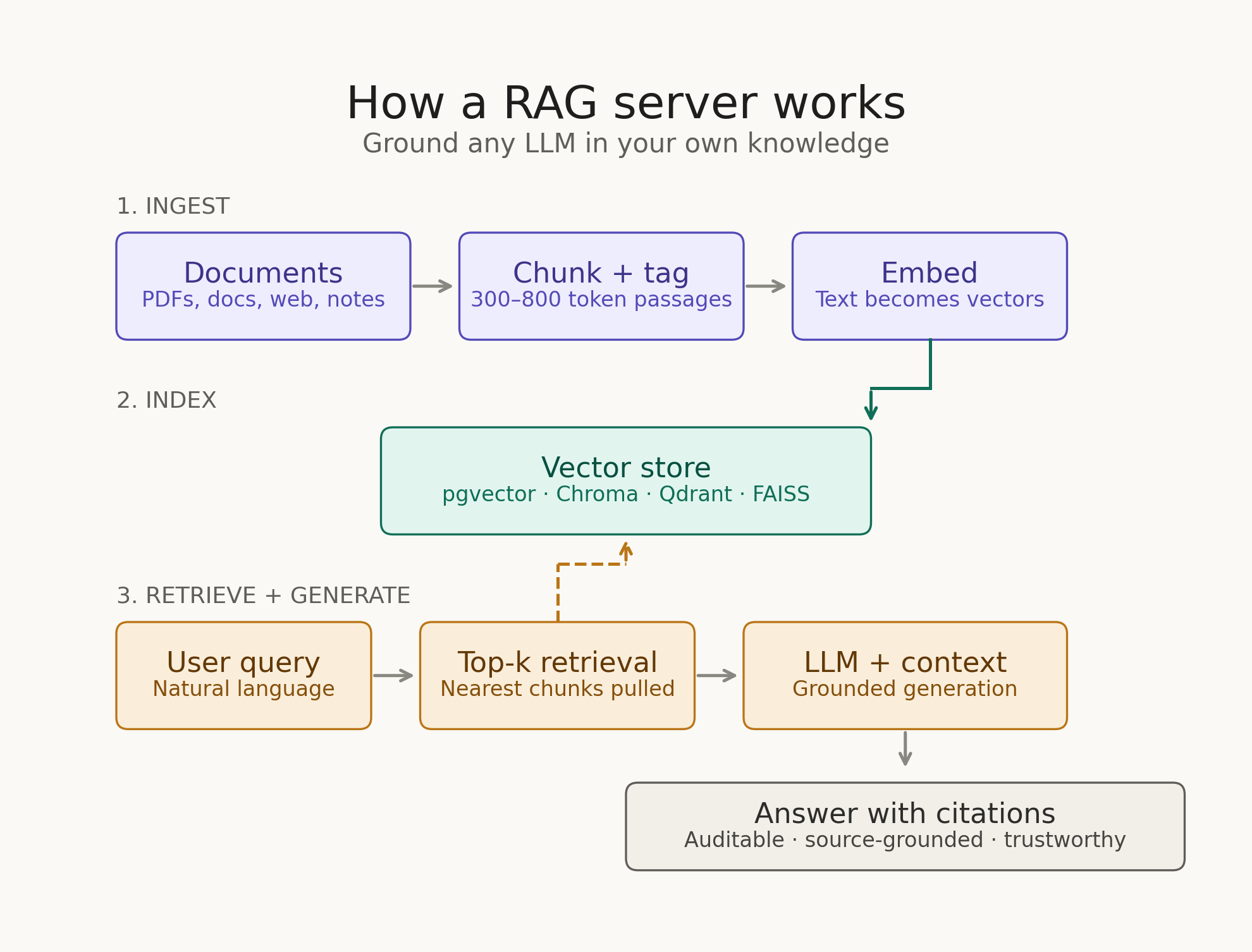
Built a RAG server recently and wanted to share the mental model that finally made it click.
Retrieval-Augmented Generation sounds complex, but at its core it’s just three moving parts working together:
1️⃣ Ingest
Take your source documents (PDFs, markdown, web pages, transcripts — whatever) and split them into chunks small enough to be meaningful but large enough to carry context. 300–800 tokens is a reasonable starting range. Attach metadata to every chunk: source, date, section, anything you might want to filter on later.
2️⃣ Embed + Store
Run each chunk through an embedding model to turn it into a vector. Store those vectors in a vector database (Chroma, Qdrant, pgvector, FAISS — pick based on scale and ops comfort). The database becomes your semantic index: similar meaning lives near similar meaning in vector space.
3️⃣ Retrieve + Generate
When a query comes in, embed it the same way, pull the top-k nearest chunks, and pass them to an LLM as grounded context alongside the user’s question. The LLM answers using your data, not just its training set.
A few lessons that saved me time:
• Chunking strategy matters more than model choice. Bad chunks = bad retrieval = bad answers, no matter how good your LLM is.
• Always return sources. Citations turn a black box into something you can audit and trust.
• Hybrid search (semantic + keyword) outperforms pure vector search on most real-world queries.
• Start with a simple Flask or FastAPI endpoint. You don’t need a framework until you do.
• Log every query, retrieval, and response. You can’t improve what you can’t see.
The magic of RAG isn’t the AI part — it’s that you can ground a general-purpose model in your own knowledge without retraining anything. A weekend of work gets you something genuinely useful.
What’s your go-to vector store these days?
#RAG #AI #MachineLearning #SoftwareEngineering #LLM